

From the Editor: This one if brought to you by – of course I can cut and paste – can’t everyone?
I try to keep my ears to the tracks but the older I get … the older I get. Still, my geezer decoder ring allows me to understand a bit from that panorama of views. #OldGuyLeaders
I’m glad to call Joe Biden my president which shouldn’t come as a surprise. Our own orange criminal never shuts the fuck up – he’ll get no play here. Paying attention as best I can requires that I lean in to what President XI and other current leaders are saying these days. I am an unapologetic supporter of Vladymyr Zelenskyy. There are several I’ll skip this time around but Vlady’s going to be center stage.
My disdain for this murderous criminal knows no bounds.
What follows are his own words or those put into his mouth by speech writers. Be that as it may. Pack a sandwich – this one is a hike. I’ll try not to interrupt too much but when I do – it will be in THIS COLOR. wbc
November 17, 2023

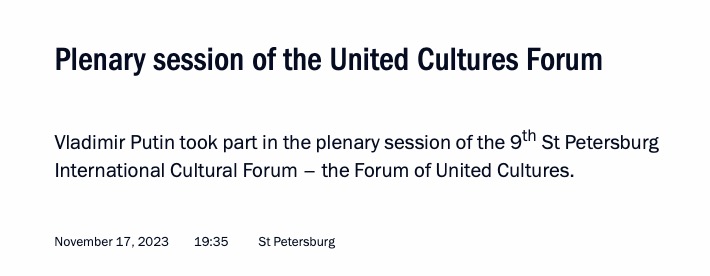

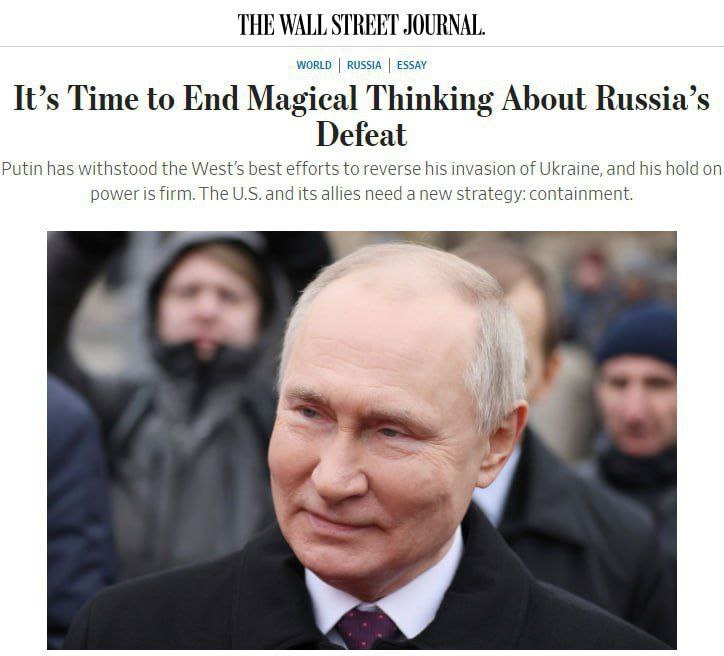
President of Russia Vladimir Putin: Good afternoon, friends! Ladies and gentlemen!
I am very happy to welcome you to St Petersburg.
Symbolically, this city has traditionally hosted the international cultural forum because our northern capital is a unique example of the mutual enrichment of Russian and other world cultures.
St Petersburg was created by outstanding architects from several diverse countries. It is a concentration of brilliant achievements by great writers, musicians, scientists, actors and thinkers in the broadest sense of this word. Their creative works have become an inalienable part of the cultural heritage of our world.
St Petersburg is also one of the visible incarnations of the worldwide responsiveness of the Russian people, the Russian soul that was described, among others, by Fyodor Dostoyevsky. It also reflects their ability to comprehend, accept and develop all the best things rather than underscore the differences, to find commonality, rise to the height of mutual spiritual enrichment and go forward together. These principles have been close to Russia and our people throughout our history. A country-civilisation, Russia has carefully kept the languages and traditions of all peoples living in it and is a unique unity of a multitude of distinctive cultures.
The experience of the millennium-old history of our country convincingly shows that cultural diversity is the greatest blessing while the interaction of cultures is one of the conditions for stable and peaceful development. After all, some of the main reasons for today’s international tensions are rooted in the claims of some forces to exclusivity, including cultural exclusivity, their disregard for the customs and spiritual values of others, a striving to subject everyone and everything to unification under their own pattern that they consider the best and most universal. This distasteful globalisation and, let me add, cultural expansionism, have led to cultural suppression and deprivation and have multiplied the potential for conflict.
We are convinced that the future belongs to free, multilinear, and diverse cultures, the broadest possible dialogue of humanitarian communities in the multipolar world that is forming today. As I understand it, the current Forum of United Cultures is intended to be a part of this dialogue. We believe that creatively-minded and enlightened individuals want to build a fair, sustainable, and secure world. We believe that this is backed by a sincere desire to improve the situation around the world in all the meanings of this word in the Russian language: the world as accord, the world as society, and the world as all humanity and the entire planet.
I am aware that you have drafted a busy programme, and understanding history through culture has become a key topic of discussion. Notably, and this is stating the obvious, archives and documentary evidence of events in the form of original sources seem to be accessible by everyone today. Well, first, not by everyone, and second, they are mostly used by specialists and professionals. Most people, however, learn about the past from books, films, theatre, paintings, and music. The truth about history and the most complex chapters of the past can undoubtedly be learned from masterpieces of world culture, including Russian, European, American, Chinese, Indian, Arab, and many other great works.
However, for those who engage in the falsification of history – unfortunately, there have always been enough of them at historical points of inflection – genuine art, so to speak, is a thorn in the side. It is in the way of these people’s efforts to distort the past in favour of their fleeting ideological or, as we often see, gender constructs, and it makes it hard for them to sow discord among people. That is why liars fabricate falsehoods in cinema, journalism, and literature.
Everything that does not fit in the mould of their historical forgeries is simply crossed out. Entire layers of history and art from Western Europe, Asia, Africa, Latin America are passed under silence, as if nothing had happened, and there have recently been attempts to cancel our culture altogether. I say “attempts” because, by definition, we understand that this is impossible, but nevertheless, they are trying to cancel a culture that is based on genuine freedom and graciousness, love for humanity and spirituality. In and of itself, a policy of canceling Russia is anti-cultural, neocolonial, and racist.
But the truth is that the authors of these ideas had issues with this infamous cancellation, just like with the so-called anti-Russia sanctions, right from the very beginning. One of many examples is the enormous interest in the International Tchaikovsky Competition. The online audience exceeded 50 million people.
How about 900,000? … wbc
In the modern world, canceling such things is simply not possible. It is strange that the people who are trying to do so do not understand this. By the way, of these 50 million people, more than half are residents of Europe who do not want anyone to decide for them what music to listen to, what to watch, and what to read.
Despite all the bans and sanctions, art still has no borders. It has always been that way, and it will undoubtedly be that way especially so in our time of rapid technological progress, which creates both vast opportunities and new risks. We must calculate the consequences of these fundamental tectonic processes, achievements in genetics, quantum mechanics, AI technology, and other innovation-driven areas.
As I understand it, this issue has also become a subject here at the forum, and it is certainly logical: only culture can ensure the safety and reasonability of innovation. Culture is the most natural ethical regulator of technological progress. The forum organisers suggest considering this as the basis of social development and humanism. As a carrier of national identity, traditions and the faith of our fathers, it serves as a guarantee of preserving our spiritual roots. This is extremely important both for the individual and for the country as a whole; it protects us from everything superfluous and momentary, gives us stability in the face of challenges, and serves as a moral reference point that allows us to remain human in the most difficult conditions.
The whole world was shocked by the news that the legendary ancient Arch of Triumph in Palmyra, Syria, was destroyed by terrorists, and for us the very word “Palmyra” is also a symbol. I would like to draw your attention – the Russian part of the audience knows this, and I will tell our friends and guests from abroad – the fact is that the city we are in, St Petersburg, is also called the Palmyra of the North from time to time. During the siege of the city, the Nazi barbarians and their satellites tried to destroy it in the same way.
In 2016, after the liberation of Palmyra in Syria, our experts from the Institute for the History of Material Culture took urgent measures to save the monument: they examined the ruins of the arch, fixed every fragment, created a unique project for the restoration of this UNESCO World Heritage Site, and soon, together with their Syrian colleagues, will begin recreating it.
Russia and our people have a deeply recognised responsibility for the preservation of world heritage and traditional values. It is in our national character to be sensitive to the pain of others and to strive for justice, as well as to care for the preservation of our common heritage – I am referring now to the Russian language. It has been and remains a language of inter-ethnic communication for hundreds of millions of people around the world. This is confirmed by the initiative of the President of Kazakhstan, Mr Tokayev, to establish an International Organisation for the Russian Language. The proposal was certainly supported by Russia and our colleagues, the leaders of the CIS countries, but there is no doubt that the number of members in this organisation will grow.
Next year Russia will chair two international organisations at once: BRICS and the CIS. A large cultural programme has been planned. We are also looking forward to increasing cultural and humanitarian cooperation with the states of the Shanghai Cooperation Organisation, ASEAN, and the leading regional associations in Africa and Latin America.
We are paying great attention to culture at the state level. We are spending considerable funds on its development and are certainly not planning to reduce this funding. On the contrary, we will be seeking additional reserves, supporting creative figures and organisations, programmes for the protection of monuments and development of historical cities, and launching unique projects based on digital solutions. One is the already operating Pushkin Card. This cultural and educational programme for youth allows every Russian citizen between 14 and 22 to visit museums, theatres, concerts and other cultural institutions at state expense. Such commonly available educational programmes are not only opening art to young people, but also serving to assert the principles of equality and social justice.
Domestic businesses are also playing a creative role in cultural development. They are preserving the cultural heritage of the peoples of Russia, opening new creative spaces, some at former industrial zones, and replenishing the collections of our museums and libraries with priceless artefacts. They are doing all this from the heart. This mission deserves the deepest gratitude.
The participation of business people in the development of culture is a supra-national, unifying process and hence businesses, Russia’s development institutions and the EAEU, BRICS and SCO economies will come up with even more initiatives. There is no doubt of this, and I hope the theme of so-called business culture and philanthropy will become a traditional item on the forum’s agenda.
I would like to emphasise that Russia is determined to engage in the closest joint work with all those who share our values of peace, friendship and mutual respect, and who are ready to take part in creating a modern multipolar world along the lines of civilisational and cultural diversity.
The successful development of humanity depends on the preservation of the identities of people, on the existence of equal rights and opportunities for all states. The Forum of United Cultures, its discussions and ideas are designed to facilitate the achievement of these goals. Attracting more authoritative and young creative figures, pedagogues, scientists, entrepreneurs and benefactors, it is capable of becoming a permanent venue for important decision-making in the humanitarian area. No doubt, Russia is willing to ensure these efforts.
Thank you very much for being here, for being with us. Thank you for your attention.
(Applause.)
Mikhail Shvydkoy: Mr President, thank you very much for your in-depth and serious remarks.
After the applause, we could consider the meeting finished but people who have gathered here have many questions.
During yesterday and today’s discussions (there were nine sessions), we discussed – and you mentioned this – the relationship between culture and business, theatre, music, museums, artificial intelligence and cinema.
The discussions were heated. Today, we summed up the results under the guidance of Organising Committee Chair Tatyana Golikova. Nonetheless, it was clear, as Mr Gusman put it today, that we didn’t debate it enough and we need to continue. Probably, this is the continuation.
I will take the liberty of somewhat usurping the rights of the moderator and ask the first question.
All these discussions have made it clear that today culture really has many problems in the multipolar, changing world. In effect, it is rediscovering this world.
However, many people asked often enough if the timing was right for this. The world is full of tensions, uncertainties and armed conflicts. Different regions of the planet are tense and a lot is happening in this serious phase.
Is it appropriate to talk about culture at this time? There is an old saying: ”When guns speak, muses are silent.” What is your position?
Vladimir Putin: First, I think this is paraphrasing the Cicero phrase: “In times of war, the laws are silent.”
Mikhail Shvydkoy: It would be better if the muses were silent.
Vladimir Putin: I think this is so in the original, but it doesn’t matter.
What matters is that what you are doing in this area is extremely important in my opinion. Culture and sports are the conductors of understanding, without which it is very difficult and sometimes simply impossible to put an end to conflict. This is why your mission is in high demand and very noble, and something I would like to thank you for. This is the first point.
Who will build the bridges? The military finds it difficult to do this, while politicians have mutual claims, grievances and ambitions. They are fighting for their own political future and are always in the middle of fighting and arguing. Only cultural figures that are smart are thinking about the future and building bridges.
This is a mission of culture, just as it is also a mission of sports. Those who neglect this or want to block and burn the last bridges are narrow-minded and uncultured people who do not understand at all what a mission of culture is.
Mikhail Shvydkoy: Thank you very much.
Vladimir Putin: No, this is not all.
Mikhail Shvydkoy: Pardon me.
Vladimir Putin: In addition, when large-scale and acute conflicts arise, when fighting for justice is conducted in such a complicated format as an armed struggle, when such moments occur, they very often prompt creative people to make pieces of art that last for centuries.

Take Dmitry Shostakovich, for instance. He composed his Seventh Symphony when Leningrad was under siege. It motivated people to rise and fight when it was broadcast to the frontlines of the besieged city. When our athletes played football in besieged Leningrad, these games were also broadcast to the city’s frontlines. People felt a tremendous upsurge that instilled them with confidence in victory. Or take Alexander Tvardovsky’s wonderful verses: “Left bank, right bank. The snow is rough, the edge of the ice.” This is tough. You read it, and you get goose bumps for a long time.
Or take Mikhail Lermontov’s “Borodino.” I think you can wake up any person from my generation and he will know, remember by heart these words: “Oh, tell me uncle, it’s not for nothing that Moscow was burned by fire…”
Outstanding works of art are born at such turning points of history. I am hoping very much that we will see this in our day as well.
Thank you.
Mikhail Shvydkoy: Thank you very much.
Even the Musical Comedy Theatre was open in Leningrad under the siege. Filmmaker Alexei German Jr recalled this in his recent film “The Air.” People went there to receive a charge of vivacity, a charge of faith in victory.
In your remarks, you mentioned what we did for Syria’s Palmyra. Of course, this is still on the agenda, and there are some outstanding problems.
We are in the Hermitage Museum. The Director – Mikhail Piotrovsky – has done very much to implement this project.
General Director of the State Hermitage Museum Mikhail Piotrovsky: Thank you very much for mentioning Palmyra. We first talked to you about this in this hall less than ten years ago. We are seeing many results – Palmira was liberated and now we are ready to start the project on restoring the Arc of Triumph. I am hoping very much that the restoration will soon begin. I have a separate letter for you on this issue.
But there is also an even more general matter involved. This stunning project, that even UNESCO has recognised as such, rests on the experience of Soviet and Russian rescue archaeology and the artificial intelligence that we discussed a lot. It wouldn’t be possible to draft this project without the latter.
Here is my question. Are we ready – I am asking this because it requires big support from states in different aspects – to spread this experience to other countries in the Middle East where it is also needed? These include Iraq, Palestine and Israel. Their landmarks need protection as well. Can we expand this effort?
Vladimir Putin: First, I would like to thank you, a world-renown scientist, and all your colleagues for working with Palmyra at the Russian Government’s request at one time. You went there and studied it on site. I think that our scientists, our museum workers acted absolutely from the heart, without fear, and this deserves warm applause of the audience. Thank you very much.
(Applause.)
I will simply recall this because some people know this while others do not. A team got together and went to Palmyra in Syria where hostilities were still ongoing. They left and the shooting began there. So, it was clear that these people actually risked their lives. By the way, I think you made a computer layout and gave it to Syria, right?
Mikhail Piotrovsky: Yes, we gave them a computer plan.
Vladimir Putin: Yes. A big, modern computer layout was made and given to Syria. Of course, it is necessary to start this big project, and we will support it. We will do this, we will work on this. This is the first point.
A second point regards other hot zones. Naturally, it is necessary to create conditions for this kind of work. What kind of work can be done now in Palestine, in the Gaza Strip? I won’t offer my political opinions, everyone has his own view, but horrible things are happening there. I am sure that there is no possibility for this work there at this point.
Maybe it is possible to work in some areas in Iraq. Of course, it is necessary to conduct preparations for it with the local authorities. We can do this, talk to them, and our colleagues will certainly support us.
Mikhail Shvydkoy: Thank you very much.
Thank you, Mr Piotrovsky. This is indeed an outstanding project – the whole world has heard about it.
Mr President, sometimes I will say straight what I think and this is not fawning but the full truth. After your visit to Kazakhstan, my Kazakh colleagues started saying that the media in Russia began to write more positively about Kazakhstan and the media in Kazakhstan began to write more positively about Russia. And this is true.
New Minister of Culture and Information of Kazakhstan Aida Balayeva is here.
Minister of Culture and Information of Kazakhstan Aida Balayeva: Mr President!
First, allow me to thank you for the sincere and warm reception accorded to us on hospitable Russian land.
Since we are discussing the development of culture, we should certainly mention the issues of the creative industry that is closely connected with culture and new technology. Of course, this is prompted by the economy, by the market.
That said, I have the following question: what if we lose the special meaning of culture at a time when all areas are being modernised? This applies to classic culture as well.
Thank you.
Vladimir Putin: In other words, can modern technology replace what culture is doing?
Aida Balayeva: Yes, in a sense. We are now seeing some symbiosis where theatre plays are staged in a new way or there is a symbiosis between theatre and circus. Are we facing the threat of losing classical culture?
Vladimir Putin: You know, when cinema emerged, everyone predicted the death of the theatre. But it has not died. It continues to develop.
True culture will never die. Culture will exist as long as there is a human being with a heart and a soul. Other things may create new opportunities. This is true.
Aida Balayeva: Thank you.
Vladimir Putin: There is electronic music in the music area. It probably can be used and is being used.
I mentioned sports. Now we will hold new competitions, [the “Games of the Future”], that combine classic sports and cyber sports. Modern technological achievements are creating new opportunities in culture as well. But these are opportunities based on creativity, and they are the foundations of culture.
Mikhail Shvydkoy: Thank you very much.
Mr President, you said, and we are aware, that Russia will chair BRICS next year.
The recent BRICS summit at which the audience listened to your speech with great attention, was held in Johannesburg, in South Africa. At that time, we met with Zizi Kodwa, the Minister of Sports, Arts and Culture. This is the ministry that brings sport, art and culture together. Mr Kodwa is here.
Minister of Sports, Arts and Culture of South Africa Zizi Kodwa. Please, welcome.
Zizi Kodwa: Thank you very much, Mr President. Please receive the warm and emotional greetings from the people and the government of South Africa. Mr President, let me thank you for elevating culture as a tool and an instrument for building bridges of peace. And I think that is very important. But today’s challenge, Mr President, and you agree with me, is justice and everything we see is the disintegration of the unipolar world. By day, by hour, by minute, it is disintegrating. In the context of the Global North and the Global South, what are the possibilities of justice in the multipolar world?
Thank you very much, Mr President.

Vladimir Putin: I see the multipolar world as fair. You said yourself that there is a general trend towards enhancing the level of justice.
I have already spoken about this. In my opinion, this is not just idle words. After all, the wealth possessed by many countries, especially the European states and the United States, was largely based on the injustices of the past and the former world order, on colonialism and slavery. And the technological advantages that part of humanity received at a certain point were not used fairly. They used them to assert their domination. Attempts to do this continue up to this day. This is the real essence of the current events, if we discard important, albeit still secondary factors. This is the essence of the current events.
You have hit the nail on the head – the goal is to make the world more just. Multipolarity is one way to do this. What should this world be like? It should consider the interests of all countries and peoples. They are not just taken into account but are arranged in such a way as to balance all interests.
I will not go into detail on certain current events or I would be talking about them until the morning, but the main goal is to make the world more balanced and to consider the interests of each other.
This is exactly what we are trying to do, say, in BRICS. Now I would like to recall how the recent summit was held. I watched with surprise how President of South Africa Mr Ramaphosa conducted it. I will tell you why I was surprised. One of the main themes was the expansion of BRICS. There were different approaches and different opinions – should this be done at all, should it be expanded or not, how should it be done, and so on. He probably returned to this subject about 50 times although the summit participants had different positions and went from one side to the other. He returned them to “the centre of the field” in a very neat, polite and diplomatic way every time. Eventually, we resolved the issue.
This is a very good example of how it is possible and necessary to seek a compromise and achieve it without imposing some view on others. This is how BRICS is built in general. It is not some bloc, especially not a military bloc, but it does create conditions for reaching mutual understanding. This is the way to go, and this is how we will work, including in BRICS that we will chair starting next January.
Thank you.
Mikhail Shvydkoy: Mr President, may I ask a clarifying question? It remains a mystery to me. With five member countries in BRICS now, we can achieve some sort of compromise and consider every voice. However, with eleven members and the next 20 or so waiting to join – how can this be done? How can we ensure that everyone’s voice is heard and everyone’s interests are respected?
Vladimir Putin: It is difficult, but we should strive for it. There is simply no other way to reach a compromise. And we are too familiar with the alternative: proclaiming that someone is exceptional in relation to others and dividing people into first and second class, like meat. This should not take place in human society. It is unnatural.
Mikhail Shvydkoy: Thank you very much.
You just mentioned that we need to hear everyone. This year, we mark the 125thanniversary of the Moscow Art Theatre. As Konstantin Stanislavsky put it wonderfully, “When you enter the stage, you must act as someone else.” Probably, the ability to hear all this extends to high politics as well.
I would like to give the floor to Konstantin Khabensky; he asked for it. Adding to what Aida Balayeva said, Chekhov Moscow Art Theatre’s performance in Kazakhstan this year, including at Baikonur, was an immense success.
Artistic Director of the Moscow Chekhov Art Theatre Konstantin Khabensky: Mr President, colleagues, good evening.
Indeed, today I am representing the Moscow Chekhov Art Theatre. It was established 125 years ago; as you know, the emergence of this theatre took place along with a massive cultural revolution in the theatre community across the globe.
Today, the Moscow Art Theatre is a place where we cherish the traditions of Russian psychological theatre. I won’t be overly modest: not only do we treasure these traditions, but we also bring them to life on stage every night. This is a place where charity plays a vital role. We tell our spectators about the charity projects supported by the actors of our theatre. This is the place of constant creative exploration, where we seek new directors, playwrights, and innovative forms. In short, this is a place that has brought together people who are passionate about their profession and life, just like it was 125 years ago.
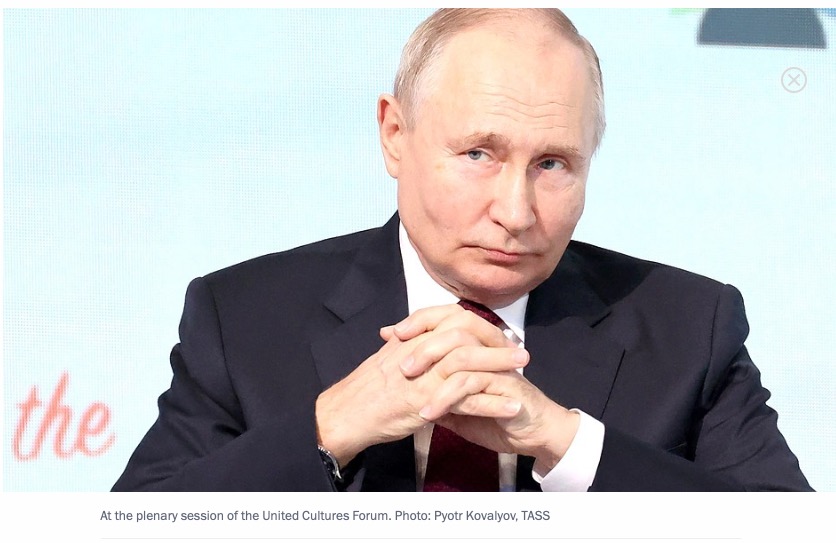
I would like to thank you for supporting our idea of celebrating the 125th anniversary. With the assistance we received from you and the Government, we have been able to implement the plans we announced a year earlier, including premieres and series of programmes, almost in full.
This also involves our friendship with Roscosmos: the theatre’s symbol was sent to the orbit, and cosmonauts Oleg Kononenko and Nikolai Chub sent a video message from there to congratulate us on the anniversary and are now probably watching a performance of the Art Theatre via video linkup. Our initiatives extend to Moscow Metro, where we have introduced a themed train, offering those who cannot visit the theatre in person an opportunity to immerse themselves in the world of the Moscow Art Theatre and its history.
Additionally, our work also includes theatre tours, including abroad. (Addressing Aida Balayeva, Minister of Culture and Information of Kazakhstan.) We visited Kazakhstan to showcase the school of Russian drama theatre, which simply cannot be replaced by any technology. It can be improved, but never replaced.
We are preparing for a tour in Japan next spring, and then in China. I have just spoken with a representative from Brazil; we have already started talks about a tour there. Last time we toured Brazil was about 20 years ago.
And yet, with all its eventful current life, the Moscow Art Theatre is only part of what we are involved in, although it is a crucial and meaningful one in the vast cultural space.
I would be interested to hear your thoughts about projects and development trajectories – this is not so much about the theatre as it is a fairly compact structure. My question is more about the role of Russian culture in a multipolar world: how do you envision it?
Vladimir Putin: You know, in this audience I can only speak as an ordinary citizen as I am neither a theatregoer nor a culture expert. I see Russian culture as an integral part of world culture, continuing to evolve on its own terms – and I am speaking off the top of my head now – while also embracing the best that the world culture has to offer. I hope it will grow and advance in this way, demonstrating its excellence yet recognising the impressive results achieved by our partners, which is quite natural. I wish for Russian culture to align itself with the best global cultural accomplishments, fostering a symbiotic relationship that allows our national culture to flourish while preserving its richness, ethnic diversity, and deep historical roots while advancing forward. That is my perspective.
Konstantin Khabensky: Thank you.
Mikhail Shvydkoy: Mr President, next year, Russia will hold the presidency of BRICS and the CIS. What cultural projects do you believe can generate interest during Russia’s presidency of these two organisations?
Vladimir Putin: I cannot recall the specific names of these projects right now, but this aspect of cooperation in the cultural and humanitarian sphere consistently remains a focal point for our CIS partners.
All the more so as the CIS represents parts of the former Soviet Union. We lived together under the roof of our common home for hundreds of years. Our destinies are intertwined, and there is a shared cultural foundation, extensive cultural knowledge and folk art. The Russian Federation and other CIS countries have many admirers and lovers of the art created by people from various parts of the former Soviet Union, because this is where native speakers of this language and representatives of this culture live.
We never forget this and, of course, we will always attach great importance to this, as well as to our common history. We consider many traditions and cultural roots to be common. I will not list everything now, but we have included all this in our plans. If you and your colleagues present here think that special attention needs to be drawn to something, we are open to it. By the way, at the end of December, we traditionally meet in St Petersburg with our colleagues from the CIS, and we will definitely discuss this too. Therefore, I have a request for you: please discuss with your colleagues and give us some feedback on what you would like to see in our joint work.
Mikhail Shvydkoy: Thank you very much. It is true that there are many projects, such as the Eurasian Film Academy, which Nikita Mikhalkov spoke about: a film academy that would connect us with Chinese cinema, and more. This includes the potential for a large TV project with a focus on popular music. In short, there are many possibilities.
Emir Kusturica has always been one of ardent supporters of fostering ties with Russian culture.
Emir, since we are on the topic of cinema, the floor is yours.
Film Director Emir Kusturica: Thank you.
Two decades ago, globalists promised us that there would be cultural diversity. In the end, what they got is sexual “diversity.” They made a cult of this “diversity,” which says: if you want to win an Oscar, then you need to make quotas in the film for transgender people, homosexuals, and others. They want it to be like that in film crews, too.
What has happened to cinema? Cinema has changed form. If 20 years ago a typical film had an authentic language, now the language, like everything else, has changed.
The language of cinema now is the language of advertising. I think that the future belongs to Russian films. I came to Russia to make [a film adaptation of the book] Laurus by [Eugene] Vodolazkin and I will adapt Dostoevsky into a film. This will be how I think and how I feel in your culture.
I think that the funds need to make original Russian cinema. Twenty years ago, everything in Moscow was like in Houston: there were billboards and there were Hollywood films.
As for Russian and Soviet films, when I was a student in Prague, I watched Shukshin, read Platonov, as well as many books that were never adapted for the screen in Russia. I have never seen a film about Shostakovich. You have so many good authors who were not represented in cinema.
I think that Russian culture will be in Russian sources. I will make two films myself. I am very glad, I can say this here. I think that the future lies in originality and in the fact that the cancellation of Russian culture in the West is impossible.
Thank you.
Vladimir Putin: Thank you very much for your art and for turning to Russian culture and connecting your plans with it. It is nice to hear. I am sure this will be very interesting. We will all look forward to seeing the results, because everything Kusturica touches turns to diamonds.
Thank you very much.
As for the first part, it is true, we can see that in order to win something at various competitions in Western countries, you need to either tell, write or show something about the life of sexual minorities, transgender people or some other transformers for whom there are many different names.
But I would like to say something unexpected. These topics and these people too have the right to win; these stories should be shown and told, because this is also part of society. This is how people live. It is wrong if they are the only ones to win all sorts of competitions; that is of no use. But this desire for equality, which I believe the South African Culture Minister spoke about, and this equality should be everywhere, in everything, including in cultural competitions.
####
.
…. w


UNIFORMED RUSSIAN BEAR SWORDS & GUNS 



…. is it warm? … is anyone warm? … ???? Oh well ….

 smallstepsgiantstrides.net
You must be logged in to post a comment.