

In a two-part analysis, we examine the shapes conflicts might take in the future – and what refugees, bots and viruses might have to do with it.
This first part focuses on the mechanics of a hybrid operation plan.
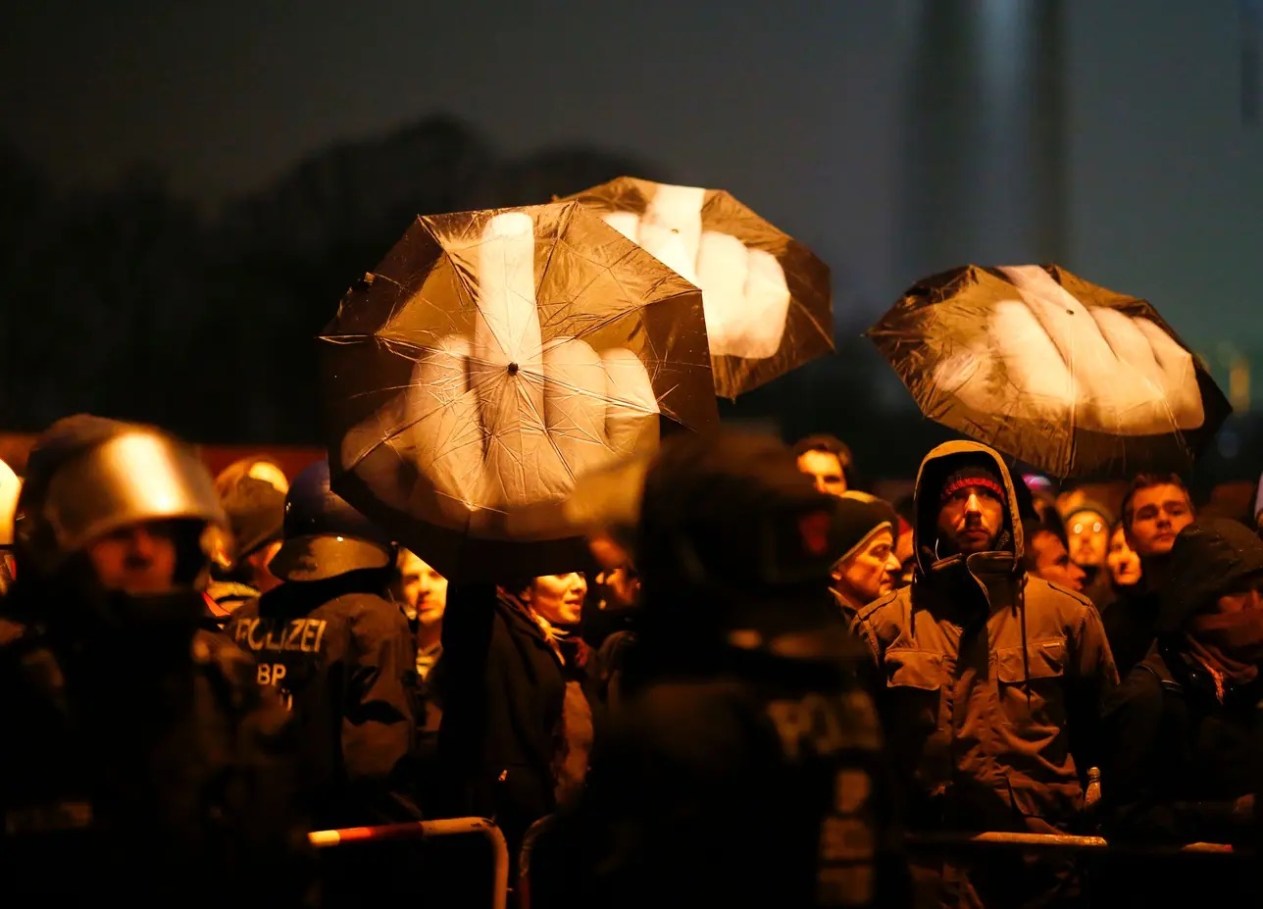

Ideal for authoritarian powers: There is considerable potential for social division between the slogan «we can do it» and the protest movement under the xenophobic name Pegida (Patriotic Europeans against the Islamization of the Occident).
It was the abrupt end of the German Willkommenskultur:
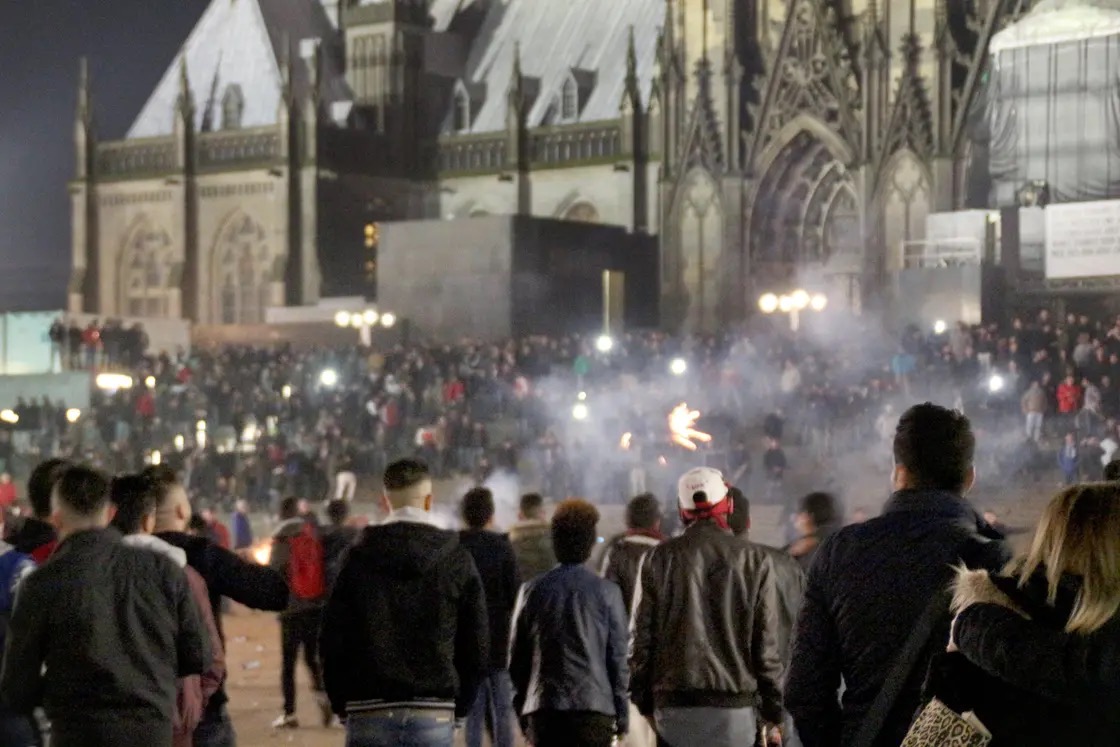
On New Year’s Eve 2015, hundreds of men, the majority of them young people from North Africa and the Middle East,
attacked celebrating women outside Cologne Central Station.
Although the police recorded around 1,200 reports, the courts only succeeded in actually convicting a perpetrator in 37 cases.
Both the authorities and the media soon agreed on a phenomenological explanation – and the appropriate Arabic term for it:
taḥarrush jamāʿī, mass harassment, a phenomenon from North Africa that had also been reported in 2011 during the protests
against the Mubarak regime in Tahrir Square.
Those who harbored vague fears of foreigners or reservations about the refugee policy of then Chancellor Angela Merkel felt vindicated.
However, these events could also be understood as part of an invisible war: a war without direct violence, but one in which the freedom and
openness of the West are misused as weapons.
Were the assaults on New Year’s Eve in Cologne more of a random eruption – or perhaps a particularly perfidious attack on
Germany’s open society?
Ukraine as a warning
For those looking to divide Germany, migration policy provides a possible starting point.
The events on New Year’s Eve in Cologne revealed the rift between the unrealistic slogan of then German Chancellor Angela Merkel
– «wir schaffen das» or we can do it – and a protest movement that had previously formed under the xenophobic name Pegida
(patriotic Europeans against the Islamization of the Occident): just outside the media’s narrative of a multicultural Germany of the 21st century.

New Year’s Eve in Cologne, 2015: In the square between the main train station and the cathedral, young men, often heavily intoxicated, assaulted young women.
Such conflicts serve as lines of operation for invisible warfare.
They lead to the centers of gravity of free states: the social diversity or the close interdependence of Western states, the hubs of power on which
«the whole depends,» as the Prussian war philosopher Carl von Clausewitz put it.
According to him, this is precisely where the collective thrust of all forces must be directe
In order to hit these centers of gravity, the use of military force tends to be avoided whenever possible.
The Russian attack on Ukraine is a clear warning to actors with imperial goals: War costs lives, money, and prestige; its duration is uncertain,
as are its outcome and political consequences.
Open, armed conflict is likely to remain the exception in order to enforce power-political goals.
Operation plan for invisible war
It is much more likely that operations below the threshold of war will intensify.
In its attack on the West, Ukraine is just one arena among many for the Kremlin.
China, too, wants to avoid a military confrontation for as long as possible in its competition with the United States.
The actors thus try to remain undetected – or at least to shield themselves well enough that they can (somewhat credibly)
deny their responsibility for any given action.
Such an approach creates maximum confusion, mutual accusations even among partners, and uncertainty.
However, it cannot be represented on a map with arrows and signatures, as is possible with movements of units on a physical battlefield.
A conflict includes political, military, economic and even social aspects.
The results of systematic analysis are used to gain a deeper understanding of a potential opponent.
This procedure follows methodology and terminology used by the Swiss Army.
First, the following elements must be mapped:
- Desired end state: What does the opponent want? One possible goal could be for individual countries in Western Europe to fall wholly or partially under the influence of an authoritarian power.
- Strategic goals: The preconditions for this are first the division of society, followed by a change in the political balance of power in certain countries, and finally a weakening of the EU and NATO. The idea is to fragment Europe and neutralize it militarily without firing a shot.
- Centers of gravity: The vectors of attack are therefore directed at the diversity of society and the interconnections among individual countries. In the Western mindset, influenced by Clausewitz, these centers of gravity are the linchpins of warfare.
Hybrid Warfare Strategies

To penetrate the centers of gravity, the adversary chooses an escalating approach along several lines of operation:
The ongoing debate on migration could be used as an attack vector against the diversity of society, as could a pandemic.
If conditions are sufficiently polarized, the next step would be to influence political conditions and encourage a change of power.
This would pave the way for the dissolution of international connections.
Covert attacks in cyberspace or operations by armed groups could be used to upset the established order.
Only now would the real actor gradually emerge and offer an alternative security system: German neutrality under the protection of Russia
or China, for instance.
The various attack vectors are timed and divided into individual phases.
The following intermediate steps are conceivable:
- Fueling existing conflicts: This phase is primarily about furthering the division of society. The credibility of political and social elites is called into question.
- Manipulation of actors: Alternatives to traditional parties must be ready, so they are supported financially long before their rise. A takeover of power is not absolutely necessary: Radical change can also be instigated from the opposition.
- Weakening the European order: If there is nevertheless a change of power in one or more European countries, the next goal is to withdraw from NATO and the EU.
Phases and vectors

Do such considerations link individual events that do not belong together?
Do they construct threats? Stoke fears?
It is part of the essence of anticipation to think the unthinkable.
This sketch of how Western states could fall under the influence of an authoritarian power is a dangerous scenario, but not an unrealistic one.
Developments in recent years have favored an attack on the centers of gravity of the West:
The large big-tent parties, or Volksparteien, based on the ideologies of the 19th and 20th centuries, are converging or disappearing
without a trace.
Angela Merkel coined the term alternativlose Politik, or a politics without alternatives.
In France, the population has in the past had to choose between Emmanuel Macron, a product of political marketing, and Marine Le Pen,
who is flirting with leaving the EU and NATO.
The prerequisite for this follows the principle divide et impera, divide and rule.
The polarization of political discourse is thus a lubricant of this invisible war.
Reality surpasses fiction
But can such conflicts also be initiated deliberately?
Did the so-called Islamic State have a hand in the events on New Year’s Eve in Cologne? Was the terrorist militia a construct with the participation of Russian intelligence services that had reactivated their relationship with the old cadres of Saddam Hussein’s Baath regime?
After all, Chechen Islamists assumed a substantial part of the military leadership responsibility for the IS.
Such questions are usually discussed behind closed doors by analysts from Western intelligence services or security experts.
There is a fine line between anticipation and conspiracy theory. In recent years, however, reality has surpassed fiction on several occasions
– la réalité a surpassé la fiction.
Over the past 25 years, the Kremlin has for instance managed to turn energy into an effective weapon.
Some Western European countries, including Germany, fell into a dangerous dependence on cheap natural gas supplies from Russia.
Politicians such as former German Chancellor Gerhard Schröder or his ally Frank-Walter Steinmeier, the current federal president, played an active role in this.
In their book «The Moscow Connection,» the two FAZ journalists Reinhard Bingener and Markus Wehner impressively show how the Kremlin was able to influence German politics via the Schröder network: with the relaxed reaction to the Russian annexation of Crimea, for instance.
By joining forces, the West was able to prevent an energy shortage last year. The warm winter made crisis management in Western Europe much easier. But energy remains one of the Kremlin’s lines of operation in its fight against the West.
Could such an attack also work with artificially produced viruses? Is a deliberately planned pandemic as an attack vector against open society possible? How might a hidden conflict escalate? Could a cyber and information war using bots escalate into armed combat?
The second part of this analysis will move from theory to the practice of invisible war.The invisible war, part 2: how authoritarian states use viruses and bots as combat tools
In the second part of our analysis of modern forms of conflict, we examine how a pandemic may function as a line of operations and illustrate methods of influence.

A pandemic may be used as a line of operations in a hybrid war. But can it also be brought about on purpose?
The open war in Ukraine is unsettling Western Europe. Before that, the Coronavirus pandemic challenged the certainties of a globalized world. What remains is the realization that a virus is able to affect individual freedom, weaken the economy, and divide society.
More than that, the pandemic has revived an old fear. What if an authoritarian government had a special virus or bacterium developed in secret laboratories and then distributed it over foreign territory? If a pandemic were deliberately planned and brought about?
Two developments are conceivable:
- In a short period of time, a large part of the attacked population dies. This could be the prelude to an invasion. In this case, the viruses or bacteria would be considered a biological weapon.
- Although only a low percentage of the population dies, fear and panic destabilize society. The government comes under fire for its health measures. The foreign power could insidiously gain control over companies or infrastructure.
These possibilities are frightening – but are they realistic?
The ideal biological weapon would be a pathogen that is easily transmissible between people and quickly infects each person. Many of those affected would become seriously ill or even die within a few days.
However, despite all modern biotechnologies and an enormously increased knowledge of viruses and bacteria, it is still not possible to build a pathogen with all these desired properties in a laboratory. Nor is it possible to construct a pathogen from already known dangerous germs such as the influenza, corona, Ebola and smallpox viruses or the plague bacterium.
No control over diseases
The problem is: No experts can currently say which gene segments of a pathogen would have to be altered and how in order to craft an efficient biological weapon from known germs. It is equally impossible at present to assemble a completely new pathogen from parts of known germs that would then have precisely defined properties.
At most, such a biological weapon could possibly be created by accident. Since the probability of this is small, a great many experiments would have to be performed. This costs time and money. And requires high-security laboratories – otherwise the experiments would lead to the death of many researchers.
But even if an authoritarian government possessed a modified virus or bacterium that its scientists thought would make a good bioweapon, that agent would have to be tested on humans. This is the only way to know if the laboratory construct is actually the desired bioweapon.
Even if a regime were indeed that ruthless, major human trials with many deaths in one country would probably not go completely undetected by the rest of the world.
Nevertheless, let’s take this thought experiment one step further. Assuming that such a new bioweapon actually existed, it would be very difficult to use it in such a way that it would harm only the inhabitants of an enemy country.
This was impressively demonstrated by the Coronavirus pandemic: If a virus is very easily transmissible between people, it quickly spreads across national borders and to other continents. Moreover, it does not simply disappear on command.
Thus, if an authoritarian government were to release a new bioweapon in an enemy country, it would not be immune to the pathogen finding its way «back home» sooner or later. Its own population would be in danger.

An artificially induced pandemic could backfire on the attacker.
It would not be possible for the attacker to completely protect the population in their own country with a specific vaccine. Many viruses and bacteria constantly adapt as they circulate in the population, which makes vaccines rapidly become less effective. This, too, has been illustrated by the recent Coronavirus pandemic.
A breeding ground for influence operations
A new bioweapon could, however, destabilize the enemy. But here the question arises: What extent of destabilization is useful for the attacker? And how quickly do they then want to achieve control of key infrastructure or businesses?
Undoubtedly, the Coronavirus pandemic has temporarily shaken up many countries, including Western industrialized nations. But now, more than three years after the outbreak, no country is still so badly affected that corporations, government agencies, or infrastructure would be easy prey. What has remained, however, are weakened state finances, resentment against the authorities and increased polarization between segments of the population.
A targeted attack using a virus or bacterium thus involves many incalculable dangers for the attacker. It is therefore much more interesting to surf the waves of an already existing pandemic.
Indeed, that is exactly how the mechanics of hybrid warfare work. It follows a plan of operations that frequently align with existing conflicts or problems: The discourses on migration, energy or even a pandemic lend themselves to furthering divisions within a society.
Phases and vectors
The operations target the most vulnerable parts of a community. The centers of gravity of the West are its social diversity and the interconnections among individual countries. If an authoritarian power succeeds in dividing a society and removing one or more states from NATO in terms of security policy, it can significantly expand its influence on Western Europe.
Hybrid Warfare Strategies
One key tactic that aims directly into the centers of gravity is the use of influence operations that exploit the gray area between truth and lies.
Disinformation as a method of reaching the center of gravity with attack vectors was tested during the Coronavirus pandemic. Fake news and half-truths were partly spread via fake profiles on social networks, so-called bots. In some cases, state actors, specifically Russia and China, were behind such information operations.
Emotions favor disinformation
In the case of Covid, the narratives pursued three objectives: to obscure the origin of the virus; to downplay the dangerousness of the virus and discredit protective measures; and finally, to sow distrust of governments and their actions and exaggerate protests.
Although it is hardly likely that China intentionally manufactured the Coronavirus in a laboratory in Wuhan, these influence operations as a whole follow an overarching goal: to discredit and weaken the West and divide society.
This is not a new goal. Russia in particular has been trying to destabilize Western countries by various means for years. Prior to the 2016 U.S. presidential election, cyber units from Russian intelligence agencies conducted influence operations. Among other things, they stole e-mails from the Democrats, which they published afterwards.
This so-called hack-and-leak action was intended to help presidential candidate Donald Trump.
In Europe, the Kremlin maintained good relationships with right-wing populist parties. In 2014, Marine Le Pen’s French Front National even received a multimillion-dollar loan from a Russian bank that is said to have close ties to Russia’s power elite.
The Coronavirus pandemic was an ideal topic for influence operations: Uncertainty was great, many people were afraid, and the interventions in everyday life were massive – and correspondingly controversial. Such emotions give impetus to rumors, misinformation or even conspiracy theories.
It is the ideal breeding ground for influence operations. These operations utilize existing narratives and either exaggerate them or modify them slightly.
Fake news portals
In such information operations, direct links to the Russian state can usually only be proven in isolated cases. In some instances, Western intelligence agencies made accusations to this effect without specifically disclosing their evidence. Nevertheless, there is little doubt that these operations took place with government support, and not only because the narratives in question correspond to Russian interests.
During the Coronavirus pandemic, the entire Russian disinformation ecosystem came into play. This includes Kremlin-affiliated news channels such as RT (formerly Russia Today) and its offshoots around the globe, which partly disseminated false or at least misleading reports.
Bots on social media, i.e. fake profiles that automatically spread disinformation, also played a key role. Bots often spread their messages along with statements from vaccine skeptics or opponents to state health measures. The result is a difficult-to-follow mix of genuine criticism, exaggerated claims and targeted misinformation – the fuel for influence campaigns.
An example from last year illustrates what such complex operations may look like. Starting in spring, suspected Russian actors built a network of fake media websites, as well as fake profiles and groups on social media networks such as Facebook and Twitter.
The originators of the websites created deceptively real replicas of over two dozen European news portals such as «Bild», «Daily Mail» or the French «20 minutes». They used these websites to publish false reports, which were then spread by accounts on Facebook, Twitter or Instagram, sometimes also as paid advertisements.
Although there is no evidence that this was a Russian state campaign, the effort put in by the creators and the costs for the ads placed on Facebook alone suggest a professional organization in the background. In addition, tracking software was used to measure the campaign – possibly in order to report activity to superiors.
Cyberattacks as part of another line of operations
It is quite conceivable that cyber attacks could have concrete political consequences. British Prime Minister Boris Johnson, for instance, found himself in need of explanation because parties were held at the seat of government despite lockdown regulations. If foreign actors are able to publicize such internal events through hacked emails, for instance, and fuel public sentiment through additional social media campaigns, a government may come under political pressure. It is conceivable that a government may fall or at least be temporarily incapacitated as a result.
In a tense situation, cyberattacks may create additional pressure. If hospitals are already at a standstill due to a pandemic, an IT system failure caused by an attack can quickly lead to chaotic conditions. This can cause fear and a feeling of helplessness in the population. Trust in the authorities may also be damaged, which in turn would be in the interest of the attacker.
This illustrates a next line of operations in the invisible war: a covert conflict involving sabotage operations against critical infrastructures. The internet is an ideal space for attacks that cannot be clearly attributed. In the language of specialists:
The attribution of cyberattacks is difficult.
State actors are able to hire a criminal group to cover their tracks:
It is considered certain that there are links between criminal ransomware groups and Russian intelligence services.
The Kremlin also uses this method on the ground: The Wagner Group, as a private army, was first employed in Syria, later in the Sahel and now also in Eastern Europe to do the «dirty work.» Since their mysterious attempt to march on Moscow, the government has publicly distanced itself from the force and its financier, but continues to profit from their services – simply without any demonstrable connection.
Modern war is invisible, has no clear fronts, and is fought in the heart of the West. To fend off the authoritarian onslaught, liberal states must protect their centers of gravity: the diversity of open societies and political-economic interdependence. A first step to achieve this is to recognize the danger in the first place.

####
..
…
“Only now would the real actor gradually emerge and offer an alternative security system: German neutrality under the protection of Russia
or China, for instance.” …
… for instance my ass ….w






 t warm? … is anyone warm? … ???? Oh well ….



 smallstepsgiantstrides.net
You must be logged in to post a comment.