

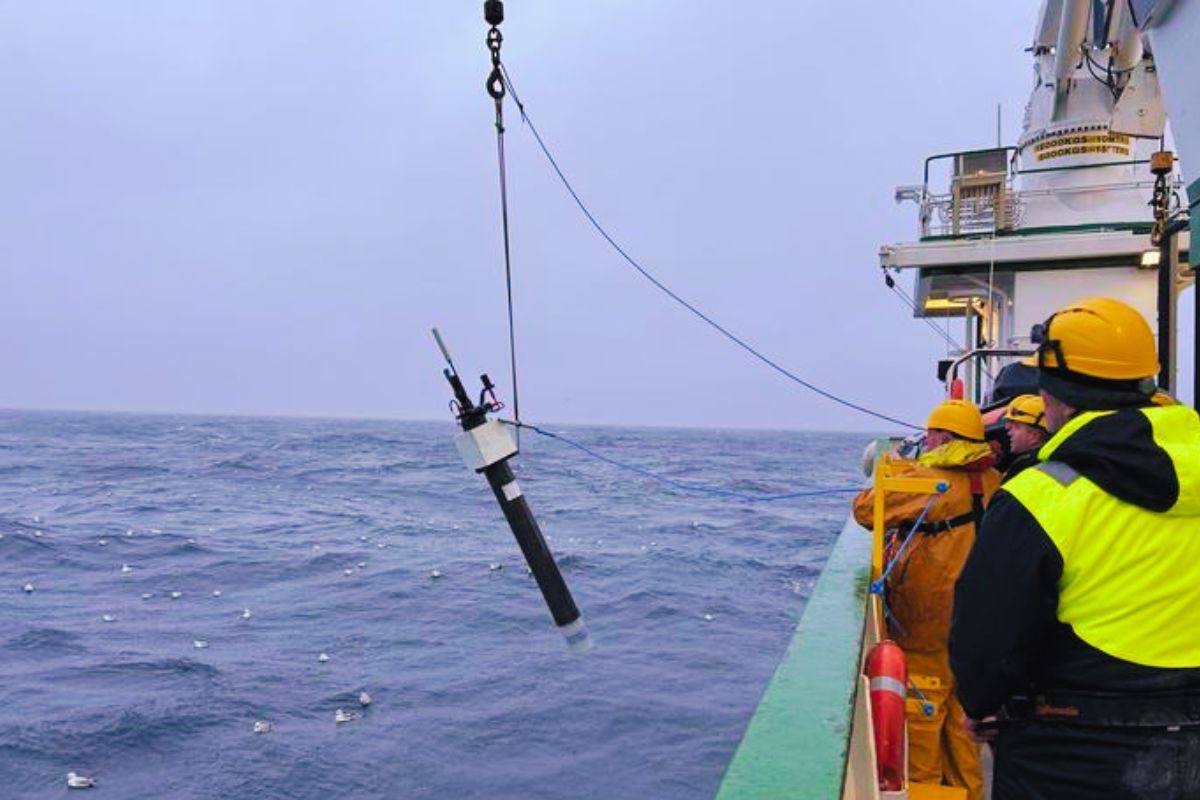
Canadian robot finds a buried weight equal to 250 million elephants beneath the ocean
Unveiling Hidden Phytoplankton Biomass
Imagine diving into the deep blue and realizing that much of what sustains life in our oceans is completely invisible from above.
That’s exactly what researchers have uncovered by using a sophisticated network of 903 robotic floats.
These devices, operating under the Biogeochemical-Argo (BGC-Argo) program, have enabled scientists to measure the global biomass of phytoplankton with unprecedented accuracy.
Phytoplankton, those microscopic marine plants that often escape the naked eye, make up an astonishing 314 teragrams—or roughly 346 million tons—of organic matter.
In other words, the collective weight hidden beneath the waves is as massive as 250 million elephants.
I recall a personal conversation with a marine biologist who described this finding as “a silent revolution,” highlighting the sheer scale of life that
thrives unseen in our oceans.
Trusted institutions like the International Oceanographic Commission have celebrated these findings for their potential to alter long-held assumptions about marine ecosystems.
The Role of Phytoplankton in Climate Regulation
Phytoplankton may be tiny, but their impact is colossal.
These marine plants form the very basis of the oceanic food chain and are key players in our planet’s climate regulation.
Through the process of photosynthesis, they not only produce around 50% of the world’s oxygen but also capture massive amounts of carbon dioxide, acting as natural carbon sinks.
I once witnessed a documentary about the hidden processes beneath the ocean’s surface that likened phytoplankton to “the lungs of the sea.”
It’s a poetic yet accurate metaphor that underscores their vital importance in buffering climate change—a view echoed by experts at the National Oceanic and Atmospheric Administration (NOAA).
Implications for Climate Change Monitoring
This revelation holds significant implications for how we monitor and predict the climate.
Traditional satellite technology, while powerful, has always had its limitations—especially when it comes to detecting life in the deeper layers of the ocean.
The robotic floats have filled this gap by providing detailed data from depths that satellites simply can’t reach.
Integrating these new measurements with satellite observations offers a more complete picture of the ocean’s carbon cycle.
This comprehensive approach is crucial, as it refines our climate models and helps policymakers devise more effective strategies to combat global warming.
Environmental monitoring organizations worldwide have lauded this integrated method, noting that it could dramatically improve our ability to forecast climate trends and natural responses.
Advancements in Oceanographic Research
The deployment of BGC-Argo floats represents a major leap forward in oceanographic research.
Unlike traditional methods that only skim the surface, these robotic devices delve into the deep, capturing a rich tapestry of data on phytoplankton distribution and biomass.
It’s fascinating to think that technology initially developed for industrial applications has now become a vital tool in environmental science.
Such advancements are not just about understanding our oceans better—they’re about safeguarding them.
By providing insights into the health of marine ecosystems, these technologies empower governments and conservation organizations to take proactive steps in preserving our oceans for future generations.
In conclusion, the Canadian robotic floats have unveiled an unseen world beneath the waves—a world whose hidden weight is equivalent to 250
million elephants.
This discovery isn’t just a scientific milestone; it’s a testament to human ingenuity and the relentless pursuit of knowledge in our quest to protect the environment.
As climate challenges mount, innovative approaches like these remind us that every tool in the fight against global warming counts, ultimately ensuring a sustainable future for our planet.
####
….. w
###







warm? … is anyone warm? … ???? Oh well ….


 smallstepsgiantstrides.net